

EV Charging Time: How to Work Out How Long Your Car Will Take
A kWh-and-kW formula, a worked table for 40 to 100 kWh batteries, and four checks that explain why your car charges slower than the calculator says.

Your EV charging time comes down to three numbers: the kWh the battery needs, the kW that actually reach it, and the energy lost on the way. The charger’s rating is only part of the second. Here’s a formula, a worked table for 40 to 100 kWh batteries, and four checks that explain why your car takes longer than the calculator promised.
EV Charging Time in One Formula
EV charging time in hours = kWh you need ÷ effective kW, plus about 10-15% on AC for losses. Effective kW is the lower of what the charger supplies and what the car accepts. Example: a 70 kWh battery from 20% to 80% needs 42 kWh; at 7 kW that’s 6 hours by division, so plan on 6.5 to 7.
The kWh you need is capacity × (target % − current %), using usable capacity if listed. For DC, the maker’s 10-80% figure beats any formula.
A real-car check: Polestar lists an 82 kWh battery and an 11 kW onboard charger for the Polestar 2 Long range. 82 ÷ 11 is about 7.5 hours; the 2026 UK manual quotes 8 hours for 0-100%, the gap being losses and the slower final stretch.
kW vs kWh: the hose and the tank
A kilowatt (kW) is power, 1,000 watts; a kilowatt-hour (kWh) is energy, one kilowatt for an hour. The US Energy Information Administration’s example: a 40-watt bulb on for five hours uses 0.2 kWh. Battery size is kWh (the tank); charger and car limits are kW (the hose).
EV Charging Levels Explained: US, UK and 230 V Markets
The charger level is the first thing that decides your EV charging time. The US Department of Energy’s charging guide gives these typical figures:
| US name | What it is | Power | UK band since Feb 2026 (old name) |
|---|---|---|---|
| Level 1 | AC, household outlet | About 1.4-1.9 kW at 120 V | Below the 3 kW bands |
| Level 2 | AC wall charger or public station, 208/240 V | 2.9-19.2 kW | Standard, 3-7.9 kW (Slow); Standard Plus, 8-49 kW (Fast) |
| DC fast, often called Level 3 | DC, bypasses the car’s onboard charger | Up to 500 kW | Rapid, 50-149 kW; Ultra-rapid, 150 kW and up; DC units under 50 kW fall in Standard Plus |
Zapmap and the UK Department for Transport renamed the two lower bands in February 2026, so many drivers still call them slow and fast. In 230 V markets such as Australia and India, go by kW: Polestar’s manual gives about 2.3 kW from a 10 A household socket, 7 kW from a 32 A single-phase wall charger and 11 kW from 16 A three-phase. Indian portable chargers often use a 15 or 16 A socket, about 3.3-3.5 kW.
EV Charging Time by Battery Size, 10% to 80%
These EV charging time estimates assume a 10-80% charge (70% of the battery) and a car that takes the charger’s full power. AC columns allow 85-92% efficiency; the DC column allows less loss, since the onboard charger is bypassed, plus a margin for units that deliver under 50 kW.
| Battery | Level 1, 1.4-1.9 kW | Level 2, 7.2-7.4 kW | AC 11 kW (48 A or three-phase) | DC 50 kW |
|---|---|---|---|---|
| 40 kWh | 16-24 h | 4-4.5 h | About 3 h | 35-40 min |
| 60 kWh | 24-35 h | 6-7 h | 4-4.5 h | 50-60 min |
| 80 kWh | 32-47 h | 8-9 h | 5.5-6 h | 65-80 min |
| 100 kWh | 40-59 h | 10-11.5 h | 7-7.5 h | 85-100 min |
A 230 V household socket at about 2.3 kW clearly beats the Level 1 column: roughly 13-14 hours for the 40 kWh row. For sessions that long, use a sound socket, ideally on its own circuit, and never an extension cord. Above 50 kW, EV charging time depends mostly on the car’s own curve (see Check 2).
Check 1: Is the Car’s Onboard Charger the Bottleneck?
On AC, the charging station only supplies power; a charger inside the car converts it to DC. The DOE lists that internal charger’s capacity among the factors behind charging time, so it sets the shortest EV charging time your car can manage on AC, however powerful the charger.
Zapmap’s Kia EV6 page makes the point: with an 11 kW onboard charger, its AC EV charging time is no shorter on a 22 kW public charger than on an 11 kW one. Onboard ratings commonly run from about 6.6 to 11.5 kW and a few reach 19.2 kW, varying by model and trim, so check your spec sheet. The supply can also be the limit:
- Phases. At 230 V, one phase at 32 A gives about 7.4 kW; 11 kW needs three phases at 16 A. In most 230 V homes, where single-phase wall chargers stop at 32 A, an 11 kW car gets about 7 kW, and some cars get less, so check your manual’s single-phase figure.
- US circuit size. Most home Level 2 units run at up to 30 A for 7.2 kW on a dedicated 40 A circuit (NEC Article 625). A 48 A unit gives about 11.5 kW but needs a dedicated 60 A circuit sized by a licensed electrician. In Canada, the Canadian Electrical Code applies.
- Current settings. Never raise a charging-current limit above what the circuit was installed for: an overloaded circuit is a fire risk. Within that limit, check that the car’s charging menu or the wall charger’s app hasn’t been turned down.

Check 2: Why Charging Slows Down Near 80%
The car cuts DC power as the battery fills, usually gradually and then steeply near the top. Polestar’s manual says power is limited toward the end of fast charging, and the DOE notes it varies with state of charge. Makers usually quote 10-80% (some sources use 20-80%), so compare like with like. Plug in at 70% and even a big charger looks slow.
More kW doesn’t always help either, because the car caps its own peak. The 2026 Polestar 2 manual lists 10-80% times for the Standard range of 62 minutes at 50 kW and 34 at both 150 and 200 kW, since it peaks at 135 kW; the Long range (205 kW peak) takes 68, 29 and 28. Past that point, the car, not the charger, sets the EV charging time.
Polestar’s spec page lists a faster 26 minutes for the current Standard range battery, so check your model year. The lesson: compare 10-80% times, not peak kW, and unplug near 80% if the next charger is close.
Cold, Heat and Losses: What an EV Charging Time Calculator Leaves Out
Check 3: Is the battery too cold or too hot?
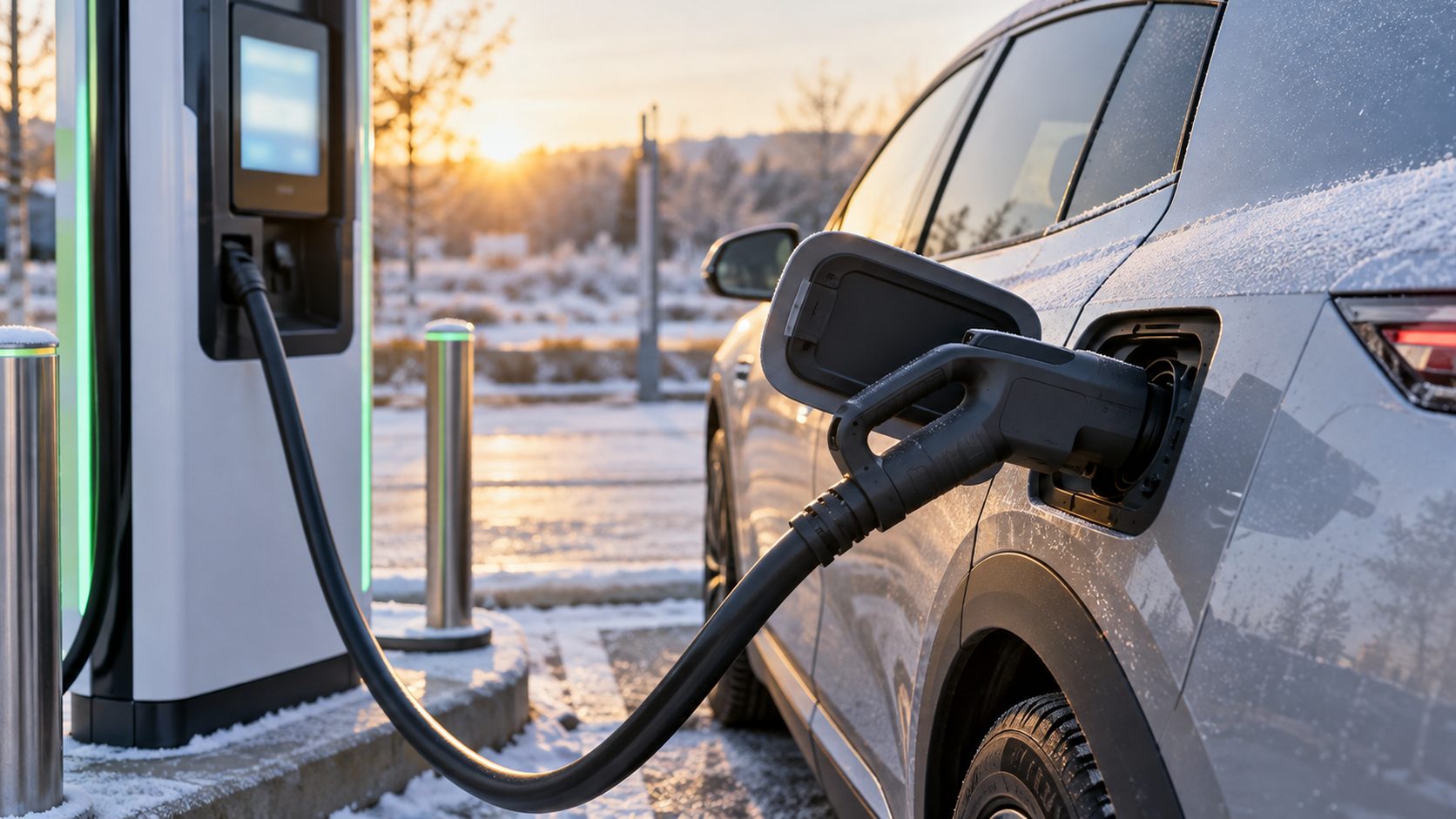
Polestar’s manual says cold or hot weather lengthens charging because part of the current heats or cools the battery; its DC times assume a pack at about 35 °C (95 °F). The fueleconomy.gov charging guide also lists ambient temperature, so a winter EV charging time can run well past the table.
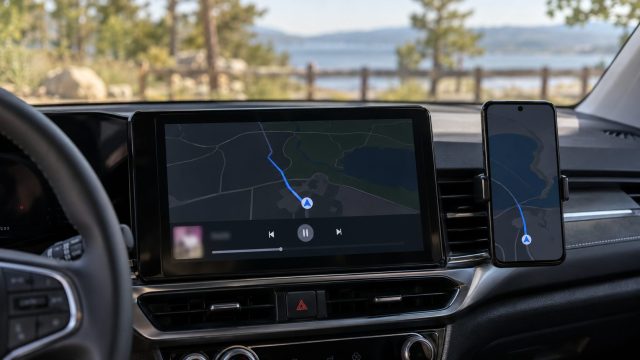
Preconditioning helps: the Polestar 2 brings its battery up to temperature when you set a fast charger as the destination in its built-in Google Maps. Other cars use other triggers, so don’t assume a phone app on Android Auto does the same; if that projected map locks up, see our fix for when Android Auto keeps freezing.
At home, fueleconomy.gov’s cold-weather tips suggest parking somewhere warmer, such as a garage. Preheating the cabin while plugged in, another tip there, saves range but draws charger power, so it won’t speed up charging.
Check 4: How much is lost between the wall and the battery?
Battery charging efficiency is often 84% to 93%, according to fueleconomy.gov’s EV technology page, so roughly 7-16% of the energy drawn never reaches the battery. Heating or cooling the cabin while plugged in adds more; Polestar’s AC times assume it’s off.
An EV charging time calculator that only divides kWh by kW misses all of this, plus the slow end of the curve. Treat its answer as the best case.
Estimate Your Own EV Charging Time in Four Steps
Find your car’s numbers
Look up usable battery capacity and maximum AC and DC charging power in the owner’s manual or the maker’s spec page.
Work out the kWh you need
Multiply capacity by the change in charge: a 75 kWh battery from 20% to 80% needs 45 kWh.
Pick the effective kW
Take the lowest of the charger’s rating, the car’s limit and, on AC, your supply. An 11 kW car on a 22 kW three-phase charger means 11 kW.
Divide and add a margin
45 ÷ 11 is about 4.1 hours; add 10-15% and your AC EV charging time is roughly 4.5 to 4.7 hours. For DC, use the maker’s 10-80% figure and allow extra in cold weather.
If EV charging time suddenly jumps on a charger you use often, in mild weather and from a low charge, check the simple things first. At home, make sure the wall charger isn’t in an eco, solar or load-balancing mode and no timer or charge limit is set. On some public sites, a second car on the same unit shares its power, so try another charger or cable. If it stays slow or the car shows a charging fault, have the dealer check it.
EV Charging Time: Quick Answers
How long does a Level 2 home charger take?
At about 7 kW, EV charging time from 10% to 80% is roughly 4 to 4.5 hours for a 40 kWh battery and 10 to 11.5 for a 100 kWh one. An 11 kW car on a suitable supply is about a third quicker; your manual lists exact times.
Is Level 3 the same as DC fast charging?
In practice, yes. “Level 3” is a common nickname, even at the DOE, but not the formal SAE name: SAE J1772 defines AC Level 1 and 2 plus DC Level 1 and 2. UK drivers say rapid or ultra-rapid.
Can I estimate EV charging time from miles of range per hour?
Only roughly. The fueleconomy.gov charging guide says Level 2 adds anywhere from a few miles of range per hour of charging to about 40, depending on the vehicle. Dividing kWh by kW is more reliable because it doesn’t depend on your car’s miles per kWh, which varies with speed, weather and model.
Use Ranges, Then Check the Manual
Treat any formula result as a range. If your real EV charging time is longer, rule out settings, timers and shared power first, then check the onboard charger and your supply, the curve near 80%, battery temperature and losses.
If the car logs a fault and your code reader won’t link up, see our guide to an OBD2 scanner not connecting. More fixes are in our car tech guides.



Leave a comment