

EV Charging at Home: Outlets, Wallboxes and the Extension Cord Rule
Start with the car's own or the maker's cord on a dedicated outlet, skip extension cords, then weigh 240 V outlets, hardwired wallboxes, dryer sharing and solar.
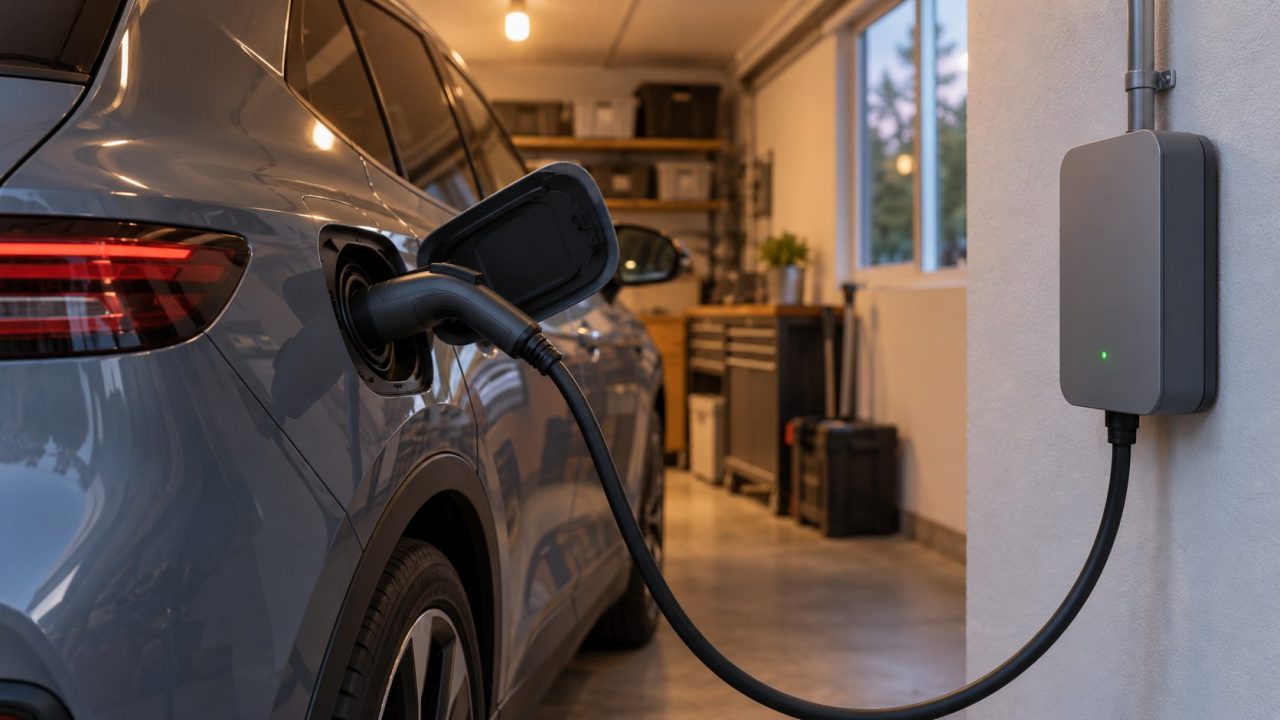
Most EV charging at home happens overnight on AC power, either through a portable cord in an ordinary outlet or through a 240-volt outlet or wall charger. Start with what you already have, since for many drivers it’s enough. Upgrade only when your miles outgrow it, and skip the extension cord.
EV Charging at Home Starts With the Outlet You Already Have
For many drivers, EV charging at home needs nothing more than a 120-volt outlet and a portable charging cord. The US Department of Energy puts this Level 1 charging at roughly 5 miles of range per hour, about 40 miles from 8 hours in a mid-size EV. The outlet should be on a dedicated circuit near where you park. In 230-240 V countries, a standard socket gives up to roughly 2.4 kW.
In the US and Canada, that cord typically ends in a NEMA 5-15 plug, the common three-prong household type. The NFPA’s tip sheet says to use the cord that came with the vehicle and to make sure the charger or outlet has GFCI protection. Not every EV ships with one, though: Tesla stopped including its Mobile Connector with new US cars in 2022, and some makers sell their cord as an option. If yours came without one, buy the automaker’s cord or a UL- or ETL-listed one.
When Level 1 stops being enough
ENERGY STAR’s rule of thumb: under about 40 miles a day, or with a plug-in hybrid, 120 volts usually covers it; above that in a full EV, you’ll generally want 240 volts. It puts Level 1 at about 2-5 miles of range per hour and Level 2 at 10-20. The DOE’s home charging guide also favors Level 2 for irregular schedules, long commutes and large batteries.
So check a typical day: 20 miles with 12 hours parked is fine on Level 1, but 70 miles with 8 hours parked falls behind. For the kWh-and-kW math, see our guide to EV charging time.
Can You Use an Extension Cord for EV Charging?
Tesla, GM, Kia, Hyundai’s 2026 Tucson Plug-in Hybrid manual, the NFPA and the US Fire Administration all say not to use an extension cord with an EV charger. Tesla also rules out power strips, multi-outlet adapters, multi-plugs and conversion plugs. Follow your own car’s manual.
An extension cord is the most tempting shortcut in EV charging at home, and makers’ fault lists show why it’s out. A 2020 GM service bulletin for the Bolt EV and Volt says most no-charge events with its 120-volt cords are likely caused by an overheated outlet or plug. Tesla’s connector cuts current when its wall plug runs hot, and stops on a ground fault, a lost ground or out-of-range voltage. An extension cord adds a second plug joint that can overheat, extra length for voltage to drop, and another link in the ground path.
Stop charging and have a licensed electrician check the outlet if you notice:
- A hot or discolored plug or faceplate. Kia says to stop using the cable immediately if any part overheats.
- A burning smell or smoke. Kia and Hyundai both say to stop at once.
- A plug-temperature, ground-fault or voltage error. Tesla’s cord, for one, slows or stops charging for each.
- A loose or poor fit. If the plug doesn’t fit, GM says not to modify it.
The safer fixes for EV charging at home are dull, but they work: park so the cord reaches (Tesla’s Gen 3 cord is 20 ft long), or have an electrician add a dedicated outlet near the parking spot. Add-on charging extension cables between the charger and the car follow the same rule: if neither your car maker nor your charger maker approves one, don’t use it.
EV Charging Outlet Types and What Each Delivers
For EV charging at home, the outlet decides how much current a portable cord can draw. These figures come from Tesla’s Gen 3 Mobile Connector manual for North America; the connector detects the adapter and sets the current itself. Other brands’ cords differ.
| Outlet (NEMA) | Voltage | Current and power | Typical use |
|---|---|---|---|
| 5-15 | 120 V | 12 A, 1.3 kW | Standard household outlet |
| 5-20 | 120 V | 16 A, 1.7 kW | 20 A outlet, T-shaped slot |
| 6-15 / 6-20 | 240 V | 12 A, 2.8 kW / 16 A, 3.8 kW | Workshops, some appliances |
| 10-30 / 14-30 | 240 V | 24 A, 5.7 kW | Dryers. The older 3-wire 10-30 has no separate ground: have an electrician check it or swap in a 14-30 first |
| 14-50 / 6-50 | 240 V | 32 A, 7.6 kW | 14-50: ranges, RV hookups, EV outlets; 6-50: welders, EV outlets |
In every row the cord draws no more than 80% of the circuit rating, in line with NEC Article 625, which treats EV charging as a continuous load. Use only adapters made for your cord and that outlet; Tesla and GM both prohibit the rest.
In the UK, the usual upgrade for EV charging at home is a dedicated wall charge point. In Australia, a 15 A socket is a middle step: the NRMA puts it at about 3.6 kW.
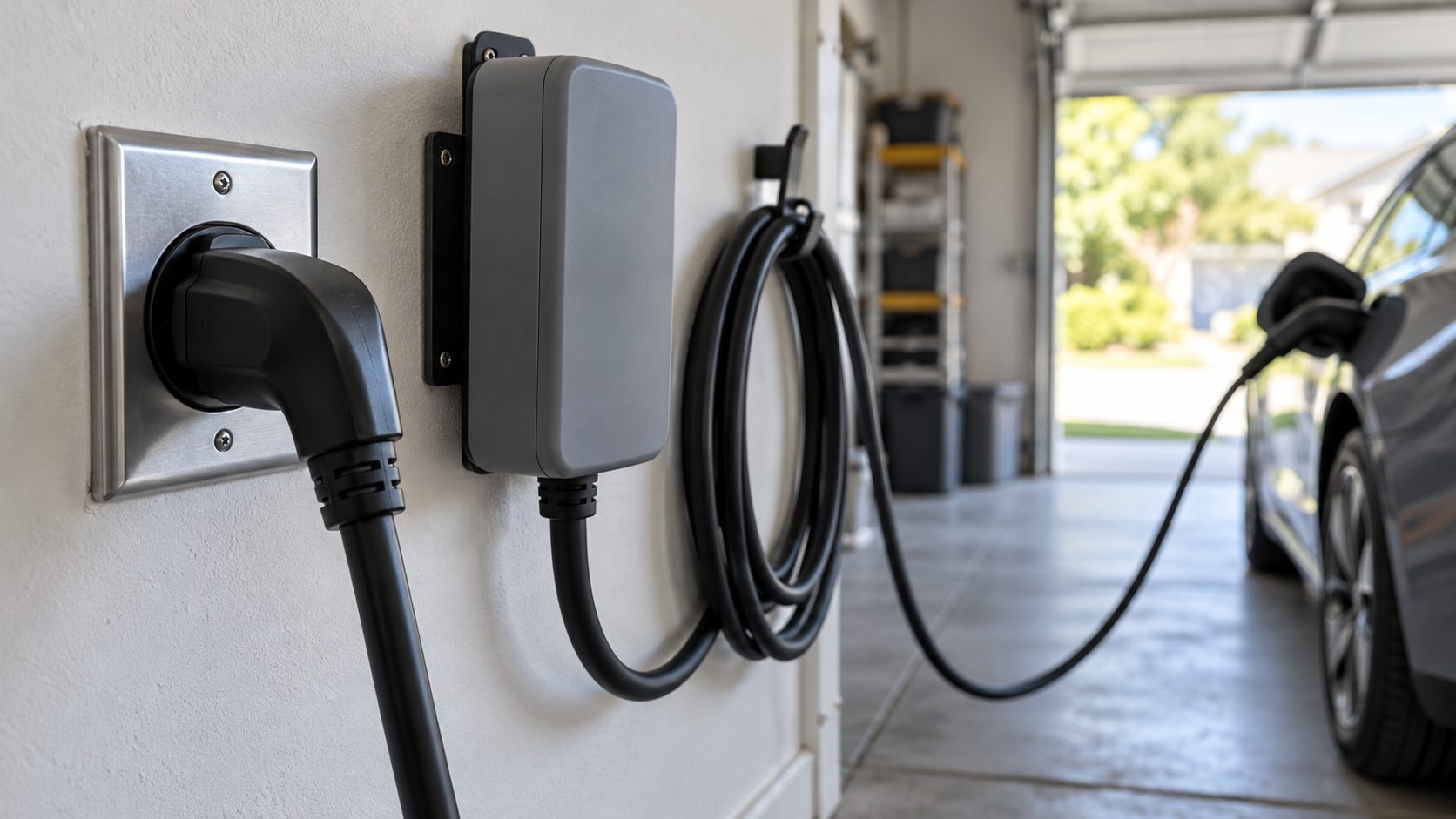
14-50 Outlet or Hardwired Wallbox for EV Charging at Home?
At 240 volts, you choose between a plug-in charger on an outlet such as a NEMA 14-50 and a wall unit wired into the circuit. The DOE says most residential Level 2 chargers run at up to 30 A (7.2 kW) on a dedicated 40 A circuit.
| Factor | Plug-in on a 14-50 | Hardwired wallbox |
|---|---|---|
| Current | Up to 40 A on a 50 A circuit (Tesla’s cord: 32 A) | Above 40 A (e.g. 48 A on a 60 A circuit) if circuit, panel and car allow |
| GFCI (US) | NEC 2020 and later require GFCI protection on EV receptacles, often a 50 A GFCI breaker; some chargers trip it | Built-in ground-fault protection; newer code editions may add outdoor rules, so ask which one applies |
| Wear | Contacts wear with repeated plugging, so Tesla advises leaving its cord plugged in. Ask for an industrial-grade receptacle torqued to the maker’s spec | No receptacle to wear out |
| Outdoors | Outlet, cover and charger must all suit the location | Fine with an outdoor-rated unit |
| Moving house | Unplug the charger and take it | Needs an electrician to remove |
Neither is automatically safer for EV charging at home: both need a correctly sized dedicated circuit and listed equipment.
EV Charging From a Dryer Outlet: Sharing Devices and Their Limits
A dryer outlet looks like a ready-made 240-volt supply for EV charging at home: on a 30 A dryer circuit, a portable cord with the right adapter draws about 24 A. Swapping plugs by hand on laundry day wears the receptacle, and a homemade splitter is never safe.
Use a listed sharing device instead. NeoCharge, for example, says its UL/cUL-listed Smart Splitter pauses EV charging when the dryer runs; its 24 A model suits 30 A dryer circuits, it’s rated for indoor use, and the car’s current is set separately.
The maker says no electrician is needed, but have one check the outlet, breaker, wiring and grounding anyway: older 3-wire NEMA 10-30 outlets have no separate ground, and GM and Tesla both rule out outlets that aren’t properly grounded.
Panel Capacity, Load Management and Off-Peak Charging
Before adding Level 2 EV charging at home, ask an electrician whether the panel has spare capacity; some homes don’t. A bigger service isn’t the only fix: where an automatic load management system caps the charger’s draw, NEC Article 625 lets the electrician size the load to that cap. Which code edition applies depends on where you live.
Off-peak and time-of-use charging
Many cars and smart chargers let you schedule a start time, so EV charging at home can run in your utility’s cheaper overnight hours if it offers a time-of-use plan.
In Great Britain (not Northern Ireland), home charge points sold since 30 June 2022 must be smart: preset to charge off-peak, with a randomized delay, and owners can accept or change the default hours; see the UK government’s guidance.
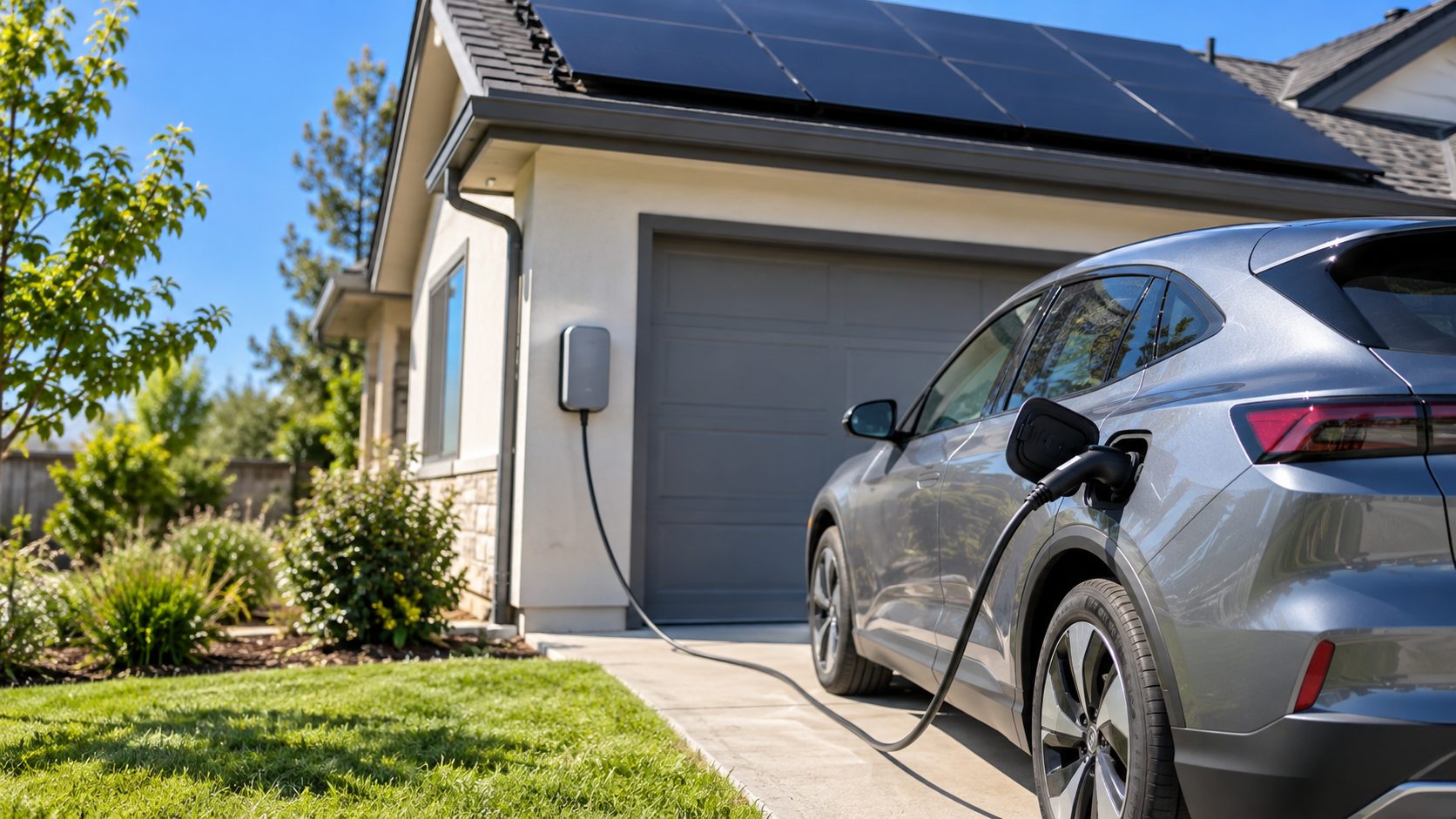
Adding solar panels to EV charging at home
Solar-aware chargers such as myenergi’s zappi follow your panels’ surplus. The zappi’s Eco mode tops up from the grid when surplus falls below about 1.4 kW, and Eco+ pauses when grid import gets too high. That floor assumes single-phase power; a three-phase charger needs about 4.1 kW unless it can switch to one phase. Solar suits EV charging at home best when the car is home in daylight; otherwise off-peak overnight charging may serve you better, and savings figures are estimates.
Planning EV Charging at Home: Questions for Your Electrician
Wiring for Level 2 EV charging at home is a job for a licensed electrician; the NFPA says a qualified one should install a 240-volt outlet. The DOE says permits may be required and many areas want a site plan approved before work starts, so check your car maker’s equipment guidance, then ask:
Is there capacity?
Ask for a load calculation, and mention a likely second EV.
Which circuit, and where?
One dedicated circuit per EV outlet, placed so the cable reaches without strain.
Outlet or hardwired?
What current the circuit will support, and for an outlet, a heavy-duty receptacle.
What protection?
Which GFCI or RCD rules apply, and whether outdoor-rated gear is needed.
Who handles the permit?
Who files it, and when the inspection happens.
Whatever you choose for EV charging at home, buy equipment certified by a nationally recognized testing laboratory; ENERGY STAR warns that some uncertified chargers sold by major retailers may carry false safety marks. Elsewhere the rules differ: BS 7671 in the UK, AS/NZS 3000 in Australia, Section 86 of the Canadian Electrical Code, and in India the Central Electricity Authority’s safety regulations and the National Electrical Code of India. Confirm what applies locally.
EV Charging at Home: Quick Answers
Do I need a dedicated circuit for Level 1, or will any garage outlet do?
For Level 1 EV charging at home, use a dedicated circuit, as the DOE, NFPA and US Fire Administration advise. The USFA warns that older home wiring may not suit charging equipment.
Is a heavy-duty extension cord OK for Level 1 charging?
Not unless your car’s manual explicitly allows it, and most don’t. A thicker cord still adds a plug joint where heat builds up. Move the car or add a dedicated outlet where you park.
Can I charge from a portable generator?
Check your manual first. GM says not to charge from portable or backup generators, and Tesla’s Gen 3 Mobile Connector manual says not to use private power generators as a charging source.
Keep the Cord, Upgrade When Your Miles Demand It
Safe EV charging at home starts with the car’s own or the maker’s cord on a dedicated, GFCI-protected outlet, never an extension cord. Move to 240 volts when your daily miles outgrow your hours parked, and keep the portable cord as a backup after a wallbox goes in.
More guides are in our car tech section. If a dashboard warning is next, see what to do when your TPMS light won’t turn off.
Leave a comment